What is an interest rate cap?

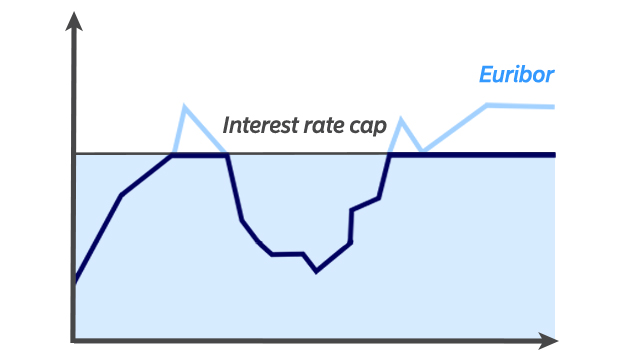
An interest rate cap is an option for hedging your home loan against rising interest rates. It will allow you to set a maximum level for the reference rate for the duration of the cap. An interest rate cap helps you protect your new or existing home loan against interest rate risk.

When you take out an interest rate cap on your home loan

  • you set a maximum level for the reference rate
  • you will benefit if the Euribor rate goes down
  • you know the maximum limit for your monthly loan payment
  • you can apply for changes to the repayment schedule as usual and use FlexiPayment.

How does an interest rate cap work?

An interest rate cap makes sure that your monthly loan payment won’t exceed the defined maximum level during the validity of the interest rate cap even if the reference rate rises above the cap. Your monthly payment comprises the loan instalment and the total interest. You can choose an interest rate cap that is valid for 3, 5, 7 or 10 years. 

What is the price of an interest rate cap?

You will pay a separate hedging fee for the interest rate cap depending on the validity and level of the cap and the amount of the loan. You can pay the hedging fee either as a higher loan margin during the validity of the cap or as a one-time payment at the start of the hedging period. 

The price and cap level of the interest rate cap are determined when you draw down the loan. If you already have a loan, the price and cap level are determined when you add the cap to your loan. 

What’s the benefit of an interest rate cap?

An interest rate cap helps you predict your future expenses for up to 10 years.

We’ll work with you to find a home loan that suits your financial situation. When selecting the most suitable home loan interest rate and interest rate hedging option, we take into account your financial situation, the market situation and how much risk are you willing to take with changes in your home loan interest rate.

“If you prefer predictability with your monthly loan payments and want to avoid surprises, an interest rate hedging levels off market fluctuations and helps you plan your personal finances in the long term,” says Jussi Pajala, CEO of Nordea Mortgage Bank.

An interest rate cap can be the right choice for you, if you want to

  • set a maximum level for the reference rate of your home loan for 3, 5, 7 or 10 years
  • benefit from falling interest rates
  • secure a maximum limit for your monthly loan payment for several years.

Want to know if an interest rate cap is the right choice for you?

We are happy to discuss an interest rate cap for your new home loan and other interest rate hedging options with you in the loan negotiation. You can also add an interest rate cap to your existing home loan at a later stage. 

If you want to take out an interest rate cap for an existing loan, please contact us. The easiest way to call is from the Nordea Mobile app – as you’re already logged in, you don’t need to verify your identity during the call. We are happy to help you find the best solution.

Frequently asked questions about interest rate caps

Example of an interest rate cap and the annual percentage rate (APR)

You can add an interest rate cap to your loan to set a maximum level for the reference rate during the validity of the interest rate cap.

Example: You take out a loan of 160,000 euros and the loan period is set at 23 years. The agreed reference rate is the 12-month Euribor and the margin is 0.47% (March 2026). You choose an interest rate cap of 3.75% for 10 years. This means that the total interest rate of your loan cannot rise above 4.22% during the validity of the interest rate cap. The APR is 3.4%, including an opening fee of 640 euros and a monthly fee of 2.50 euros for the automatic debiting of loan payments. Any fees for the interest rate cap have not been taken into account in the calculation of the APR. The number of payments is 276. The total amount of the loan and loan costs is 228,767 euros. The monthly payment (annuity) is 824 euros and does not include the interest rate cap fee which is paid separately.

The loan amount, the loan period and the interest are a representative example for the home loans offered by Nordea. The example is indicative and has been calculated using certain assumptions. The example does not necessarily correspond to the actual APR charged on the granted loan.

When buying a home, you also need to pay the costs related to the registration of ownership and pledging of your home. You also need to see to it that your home insurance is up to date. In case of a property, you will need fire insurance at the least. In some cases, we need the help of a real estate agent to determine the value of your home. We will charge a fee for this service.