.svg)
“Welcome to the fourth instalment of our article series. By taking a moment to read this article, you are taking the first – and most important – step towards making informed decisions about your estate planning. After reading this article, you will understand who is set to inherit from you. Do you feel that your current situation is appropriate and sufficient, or would you like things to be arranged differently?
If you haven’t yet read my article on the impact of your relationship on inheritance planning, I highly recommend starting there.”
Read article: Relationships, inheritance and common misconceptions
Key points from the previous article on relationships:
- A spouse does not automatically inherit – the surviving spouse’s protection is based on marital rights, not inheritance.
- Any adjustment payment received by the surviving spouse does not count as inheritance – assets subject to marital rights are first divided between the spouses before the estate is distributed.
- A cohabiting partner is in a vulnerable position under the law – without separate arrangements, they are not entitled to inheritance or an adjustment payment.
The statutory order of succession is clear
“Once the implications of your relationship status, particularly your spouse’s marital rights and entitlement to an adjustment payment, have been settled, your estate is distributed to your heirs in accordance with the law, in the following order:
1. Children
If you have children, they inherit everything in equal shares. As a rule, the surviving spouse does not inherit anything.
- If your child has passed away or renounces their inheritance, their share passes to their children – in other words, your grandchildren.
- If one of your children has died before you without leaving children of their own, their share is distributed among your surviving children.
- Only if you have no children or further descendants does the inheritance pass to your spouse.
2. Parents
If you are not married and have no children or further descendants, your estate passes to your parents.
- If a parent has passed away, their share goes to your siblings or, if applicable, to their children.
- A cohabiting partner does not inherit.
3. Grandparents
- If none of the above-mentioned heirs are alive, your estate passes to your grandparents.
- If a grandparent has passed away, their share goes to your aunts and uncles.
In the first two scenarios, children always take the place of a deceased parent. This means that your estate could, for example, pass to a great-grandchild of your sibling. In the third scenario, however, the circle of heirs is limited. This means that cousins do not take the place of a deceased aunt or uncle. Under the law, cousins do not inherit.
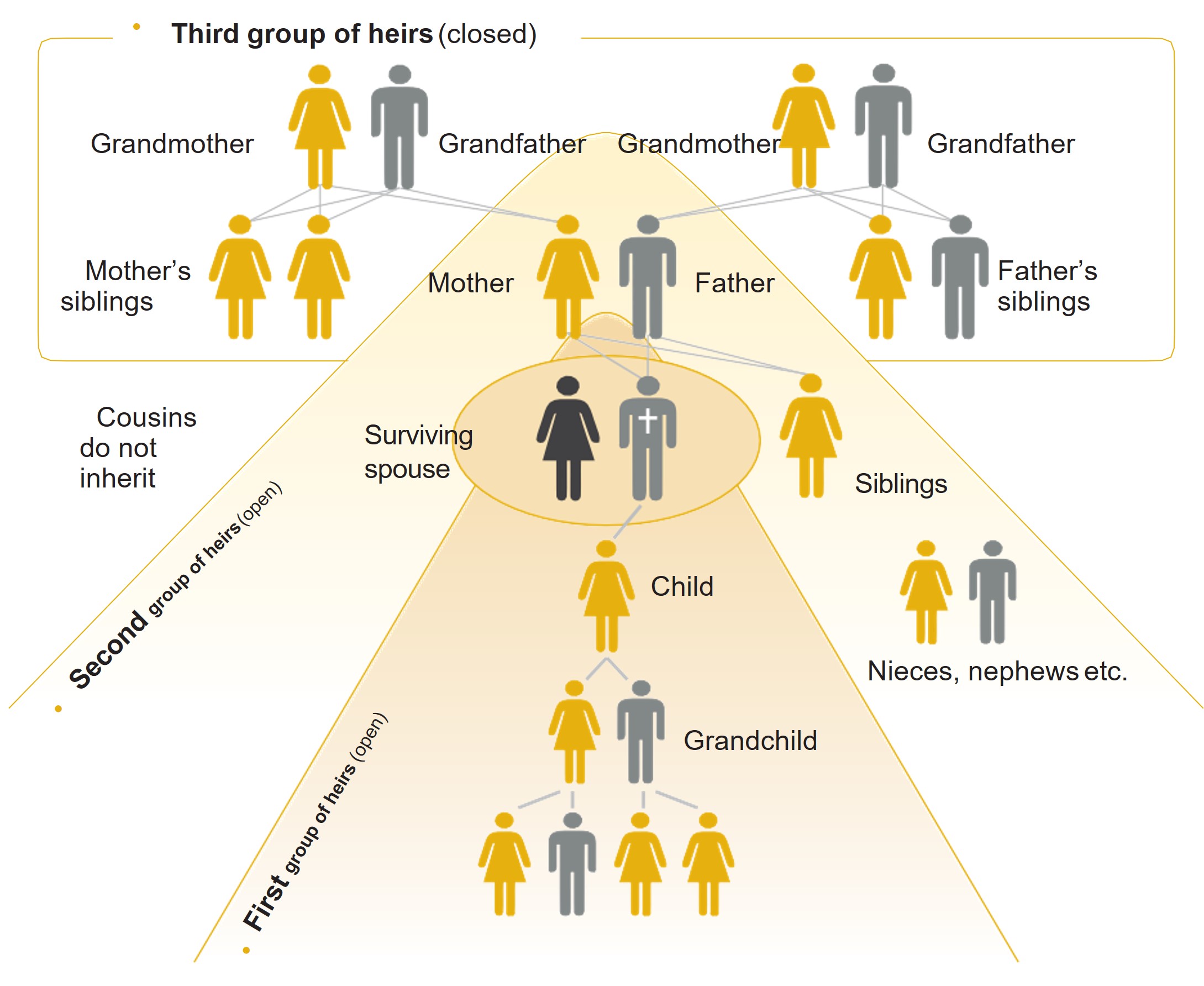
Image: Relatives are divided into three groups of heirs, who inherit the estate in a specific order. In the diagram, yellow represents women and grey represents men. The black colour used for the surviving spouse highlights their distinct status, which is not based on kinship but on marriage.
As you can see, your family situation has a significant impact on your estate planning. You should pay attention to inheritance planning especially if you and your spouse have no children or if you have a blended family. Cohabiting couples should also take measures to ensure that the surviving partner is not left with nothing.
If you want to make sure you understand how these legal aspects apply to your situation, book a personal meeting with one of our wealth management legal counsels. My colleagues and I are here to help.”